Showing posts with label drr. Show all posts

05 December 2024

Heo/Geo Lecture Series 2024-12: Jake Cadag on DRR depoliticisation

In the Philippines, non-governmental organisations (NGOs) address disaster risk through disaster prevention and humanitarian response. NGOs, however, are subjected to political persecution and violence because of their critical stance on social issues and government policies and actions that contribute to disaster risk. They face a dilemma: Commit to their stance and be subjected to persecution and violence or depoliticise approach and be able to continue their services.

For the final talk in the Heo/Geo Lecture Series for 2024 and jointly presented by the Philippine Geographical Society (PGS) and the UP Department of Geography, Dr Jake Rom Cadag analyses the political persecution and violence among NGOs engaged in disaster prevention and humanitarian response in the country through 24 key-informant interviews and a review of secondary sources. Entitled Depoliticisation is disaster risk creation: insights on non-government organisations’ disaster prevention and humanitarian response in the Philippines, the lecture happens on Friday, 6 December 2024 at 5:30PM via Zoom. 
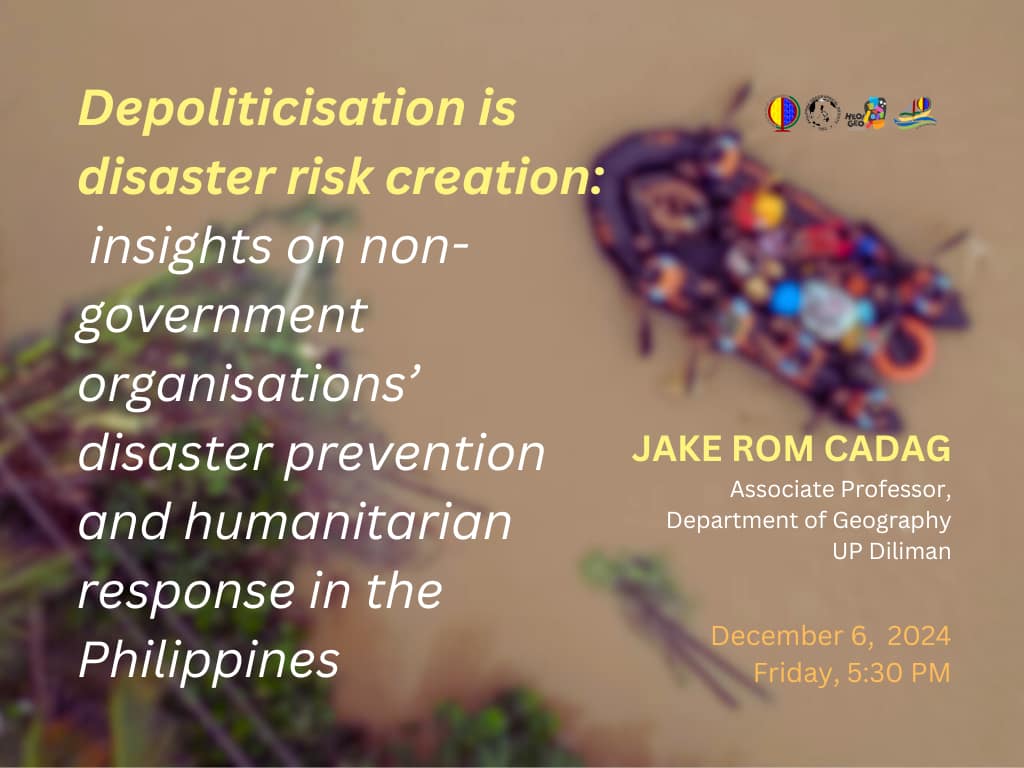

In Dr Cadag's research, the study finds that NGOs depoliticise their approach by focusing on hazard-centric programs, habitually forsaking humanitarian principles, and self-censoring and toning down public engagement. This study argues that depoliticisation is denying society safeguards against disasters associated with natural and social hazards, which lead to persistence and creation of disaster risks.

Jake Rom D. Cadag is Associate Professor of Geography at the University of the Philippines Diliman. His professional and research interests include disaster risk reduction, climate change adaptation, rural and urban studies, and participatory mapping. He is skilled in community work and the use of participatory methods and tools involving various stakeholders, including marginalized groups.  

The Heo/Geo lecture is part of the ongoing 40th anniversary celebration of the UP Department of Geography (1983-2023) which simultaneously serves and provides a space where practical, discursive and embodied discussions and performativities from academic geographers, practitioners and civil society can come together and thrive. This talk is sponsored by the Geographies of Disasters and Hazards (G-DASH) research group of the UP Department of Geography in line with the sustainable development goals #10 (Reduced inequalities), #11 (Sustainable cities and communities), and #13 (Climate action). 

To participate in the Zoom lecture, please click this link or just copy and paste this link in your browser: https://tinyurl.com/3948am3m

04 October 2024

Heo/Geo Lecture Series 2024-10: Liberty de Rivera on interrogating the rhetoric of resilience building

What comprises the right education for Disaster Risk Reduction (DRR)? This oft-asked question has long intrigued educators and field practitioners when viewing what builds a culture of safety and resilience among society's vulnerable sectors. 

For the latest paper presentation of the Heo/Geo Lecture Series for 2024, DRR will be spotlit as a global policy initiative to build resilience in hazards-exposed communities. Sponsored jointly by the UP Department of Geography and the Philippine Geographical Society (PGS) the Heo/Geo Lecture Series presents ‘Shields of the people’: Disaster Risk Reduction education for building up agents of resilience and responsibilised citizens to be presented by Dr Liberty de Rivera on Friday, 11 October 2024 at 5:30PM Philippine time UTC+8 / 7:30PM AEST UTC+10). 


For this presentation, Dr de Rivera interrogates the rhetoric of resilience building through education by investigating its contrasting features as an agentic concept and a responsibilising device. Through an ethnographic reading of DRR education programmes in Aparri town in the Philippines, she will illustrate how resilience as a polyvalent construct creates a double-bind of creating spaces for education actors and learners; participation and empowerment while legitimising patterns of deflection of responsibilities. Dr de Rivera centres the analysis on the metaphorical reference of students as Salaknib Dagiti Tattao, or shields of the people, and the designation of teachers as disaster responders to demonstrate how emerging labels and expectations about resilient citizenship must be reflexively developed and critically enacted. Inherent within these programmes are features that might depoliticise disasters and overshadow the need to uphold accountability and responsibility. 

Dr Liberty Pascua de Rivera is Vice-Chancellor Research Fellow at the Faculty of Education of Southern Cross University. Her research interests include analysing and evaluating policies and their implementation in the areas of education for sustainable development, climate change, and disaster risk reduction. Central to her research is the idea of cognitive justice—what, or whose knowledge, is emphasised, neglected, and minoritised in processes of policy cascade.

Liberty obtained her BA in Communication Research degree from the UP College of Mass Communication and her Master of Development Studies and PhD from the University of Sydney. Liberty has taught, conducted research, and engaged in development work in Singapore, the Philippines, Vanuatu, and Australia. She is the treasurer of the Oceania Comparative and International Education Society (OCIES) where she also co-leads the New and Emerging Researchers of OCIES. Liberty is an Associate Editor of the International Research in Geographical and Environmental Education (IRGEE) journal. Liberty is from the province of Apayao. She is the mother to two-year-old Kappia and partner to Ryan.

The Heo/Geo Lecture Series is a space to share and exchange ideas on a wide variety of geographical topics that intersect methodologies, discourses, technologies, pedagogies, and practices. Faculty, students, alumni and local and foreign geography and geography-adjacent researchers delivered various presentations in previous academic years fulfilling one of the Department’s mission: to popularize geography as an academic discipline through research and practice. 

This presentation is sponsored through Geographies of Disasters and Hazards (G-DASH), and the Human Geography (HuG) and Media, Literary Geographies, and Geohumanities (MELANGE) research groups of the UP Diliman Department of Geography and in line with the UN Sustainable Development Goal #3 (Good health and well-being) and #4 (Quality education). 

To participate in the talk, click this link to register: https://bit.ly/3zLBSMx

23 July 2022

PGS Lecture Series 2022-07: Juan Miguel Torres on photovoice

The political and social exclusion of women, children, older adults and persons with disabilities (PWDs) – especially the economically disenfranchised – has always been identified as a perennial problem in society. In the context of disaster risk reduction (DRR), the PWDs are among those crucially impacted by natural hazards and climate induced disasters. And yet their voices are excluded from DRR-related decision making and planning activities. With more hazards expected to be experienced, including the impending “Big One” or a strong earthquake set to happen anytime due to the West Valley Fault in Metro Manila and its peri-urban fringe, communities and sectors must be fully capacitated to be resilient to deal with the direct and indirect impacts of disasters as well as the aftermath. Hence, effective and participatory planning in the pre-emergency phase – with the inclusion of all sectors of society particularly the poorest of the four sectors – is crucial in securing and saving lives and in ensuring that appropriate systems are in place to help restore order, build resilience, and provide protection and basic services to citizens.


The Philippine Geographical Society (PGS) through its PGS Lecture Series invites Juan Miguel Torres of Salikhain Kolektib and who currently sits as project manager of Lahat Dapat Innovation Project will deliver a presentation entitled Using Photovoice as a Community-based Participatory Tool in Developing Inclusive Barangay Disaster Risk Reduction Strategies. It is happening on Monday, 25 July 2022 at 4:00PM.

For the presentation, two barangays in Pasig City, and one in Quezon City represented by different sectors of the community participated in a Photovoice project are to be spotlighted. In particular, the identification and categorization of their vulnerabilities and capabilities will discussed. The undertaking aims to identify gaps, and come up with strategies to make barangay disaster plans more inclusive.

To register, click the following link to participate in the lecture series. https://tinyurl.com/3vvzv2uy

The midyear edition of PGS Lecture Series is co-sponsored by the UP Department of Geography through the Geographies of Disasters and Hazards Research Cluster.

17 January 2022

PGS Lecture Series 2022-01: Disaster Studies Manifesto at Accord - pananaliksik at pagsasalin

Adhikain ng Disaster Studies Manifesto at Accord na nakalathala sa https://www.radixonline.org/manifesto-accord na mas pahusayin ang pag-aaral ng kalamidad at ang praktis ng pagbawas ng banta at epekto ng kalamidad (o Disaster Studies and Disaster Risk Reduction). 

Isa sa mga isinusulong nito ay ang pagamit ng wikang lokal, likas o taal (local and indigenous language) na mas akma sa konteksto at mas higit na naiintindihan lalo na ng mga pinaka-apektado ng kalamidad. At sa mas malawak pa na perspektibo, maraming aspeto na may kinalaman sa metodolohiya ng pagsasaliksik, at mga ugnayan at layunin ng mga mananaliksik, awtoridad at iba pang indibidwal at organisasyon ang maaaring suriin at bigyan ng mas akmang pakahulugan gamit ang mga lokal na wika. At upang higit na maunawaan at maipakalat ang mga nabanggit na adhikain sa Pilipinas, isinalin ng Geography 255 (Environmental Hazards and Disaster Management) class sa wikang Filipino ang Disaster Studies Manifesto at Accord. 


Hinihikayat ang mga iba pang iskolar at propesyonal sa larangan ng kalamidad na isalin ang dalawang dokumento sa kani-kanilang wika. 

Iniimbitahan ang lahat na makilahok sa presentasyon ng mga pahayag at saliw ng paninindigan tungkol sa pag-aaral ng kalamidad sa darating na Enero 21, 2021 (5:30 to 7 PM).  Para maka rehistro, i-click ang link na ito. 

Ang presentasyonng ito ay itinataguyod ng Philippine Geographical Society  at ng UP Department of Geography.

19 May 2021

PGS Lecture Series 2021-07: Soledad Dalisay on the role of cultural memory in disaster risk resilience

"Disaster memory is a strong political process: it modifies the perceptions of inhabitants ... in a powerful, emotional way," said Antoine le Blanc in 2012. Maria Kyriakidou extends this cultural logic by implicating the power of uncomfortable memory, or as she says "... there is a moral hierarchy in the way viewers remember distant suffering ... [and] constructed through the intertwined processes of remembering and forgetting" (2014, 1474).

In the latest Philippine Geographical Society's PGS Lecture Series, Dr Soledad Natalia Dalisay focuses on the functions of cultural memory in the context of disaster resilience. Entitled Cultural Memory for Disaster Risk Reduction, the talk delves into the importance of remembering disasters and the ways in which societies remember. In this lecture, cultural memory will be defined and expanded and some of the ways in which it is expressed in both built heritage and living heritage are presented. Emphasising living heritage, examples are provided in the domains of local knowledge and social practices. Lastly, issues in remembering are discussed and future directions for scholarly work on cultural memory and disasters are forwarded.


Dr Soledad Dalisay is Professor at the UP Department of Anthropology. Her research interests lie at the nexus of cultural ecologies of health, anthropologies of disaster, and gender and sexuality. She served as the first faculty coordinator of the UP Office of Anti-Sexual Harassment (OASH) for six years (2008-2014). Her latest publication is entitled Intangible Cultural Heritage which is part of the International Research Centre for Intangible Cultural Heritage in the Asia Pacific Region (IRCI) under the auspices of UNESCO.

The talk is on May 28 (Friday) at 6:00PM. Check this link to register for the lecture. https://bit.ly/3oB7wST

This talk is jointly sponsored by the UP Department of Geography and the UP Department of Anthropology.

19 September 2018

Dr. Cadag Participates in Post-Disaster Needs Assessment Workshop

Documentation from Jake Cadag

Dr. Jake Rom Cadag, Senior Lecturer, participated in a three-day seminar-workshop about Post-Disaster Needs Assessment (PDNA) on September 11-13, 2018 at the Richmonde Hotel in Ortigas, Quezon City. The event was facilitated by the United Nations Development Programme (UNDP) and the Office of Civil Defense (OCD).

Dr. Cadag's participation in the workshop is in preparation for the service-learning activities that students of Geography 255 is undertaking in the First Semester of Academic Year 2018-2019. Geography 255 students will contribute to enhancement of the practice of PDNA in the Philippines.

PDNA is a tool used to determine the value of lost assets, define reconstruction requirements, and assess the impacts on many sectors of the affected communities. For more information on PDNA, visit http://www.undp.org/content/undp/en/home/librarypage/crisis-prevention-and-recovery/pdna.html

12 September 2018

Department of Geography showcases DRRM Initiatives in 2018 UP Katatagan Fair


By Yany Lopez


The Department of Geography shared its initiatives towards disaster risk reduction and management (DRRM) at the UP Katatagan Fair. The Fair was held on September 10, 2018. It was organized by the UP Padayon Public Service Office.

Assistant Professor Emmanuel Garcia represented the Department through describing the various DRRM initiatives undertaken through its Geography 192 (Field Methods in Geography) classes Field School classes. Prof. Garcia highlighted Participatory Three-Dimensional Mapping (P3DM) projects conducted by students and faculty members in close coordination with community, local government units and NGOs. 

Prof. Garcia's also showed results of the coordinated efforts between the Deparment of Geogrpahy and  the Catholic Relief Services towards mapping building footprints in selected municipalities of Rizal.  

The UP Katatagan Fair was a one-day outdoor event that featured booths and presentations towards DRRM awareness of the UP Commmunity.  Find the Facebook Page of the UP Public Service Office here (Link https://www.facebook.com/UPpublicservice/).