Showing posts with label geography. Show all posts

04 September 2026

ICGS 2026: Stories, Places: Storying, Storytelling, and Storymaking Worlds - Call for Abstracts (First Call)

How do stories begin? 

“Many stories begin with a moment of unexpected change,” according to Will Storr in his book The Science of Storytelling. Change is hope, change is promise, continues Storr. With promise and hope, here’s a sampling how stories begin from the first lines of a random selection of books:

“First there was nothing. Then there was everything.”

(Richard Powers, The Overstory)


“Our fascination with remarkable places is as old as geography.”

(Alastair Bonnett, Off the Map)


“’Hold on. What’s going on here?’”

(Yáng Shuāng-zǐ, Taiwan Travelogue)


Opening lines in stories position and suture the readers to narratives that unspool in the next paragraphs, pages, chapters. The Storying Geography Collective maintain that stories matter because “they are central to the ways we produce and share knowledge, make meaning and communicate the world.” Stories can mean a lot to different people, communities and collectives. In geography, there is a recognition that a story is a form of worlding and geographers are storytellers that map, re-map, and un-map relations traversing bodies, natures, identities, spaces, power and various entanglements.

The storying of landscapes, lives, and processes of becoming can heighten noticing and listening to places. As Fiona Miller notes: “[s]tories have the capacity to reveal patterns across space, making manifest the changing nature of social, cultural, economic and political relations of place.” Telling, creating, embodying and performing stories, collaborative storying and even in producing counter-narratives point to the power and potential of stories in mapping a whole range of tableaus and predilections ranging from retrospective narratives to self-reflexive introspections.

Whether you are recounting narratives of island and islandness to telling stories of cartographic anxieties, the International Conference on Geographical Studies (ICGS) 2026 wants to hear them for this year’s gathering with a theme Stories, Places: Storying, Storytelling and Story-making Worlds. Happening on two consecutive days in the second week of November (13-14 November), the conference invites abstracts, panels, films, map exhibits, book talks, and geovisual storytelling sessions. The conference will be conducted remotely.

So send us your abstracts that tell stories with a broadly geographic sensibility. The topics below are incomplete but should serve as road maps for you to think through what academic research, creative project or cartographic undertakings you are working on.

- More-than-human / posthuman entanglements

- Emotional and affectual geographies

- Geospatial humanities

- Disaster risks and management

- Collaborative / participatory mapping

- Island and archipelagic narratives

- Environmental humanities

- Re-storying loss and trauma

- Digital lives and alterities

- Web 2.0 and neogeography

- Forest governance

- Geonarratives and place-based stories

- Indigenization and indigeneity 

- Storying of vernacular landscapes

- Queering geomorphologies

- Violence and carcerality 

- Historicizing spatialities

- Creative methodologies in geography

- Radical and geographies from the Antipodes

- Urbanities and peri-urbanism 

- Political ecologies

- Geocosmologies

- Storying changed climatologies

- Mourning and grieving for lost worlds

- Gender and sexualities

- Geographical / cartographical imaginations

- Social movements and progressive politics

- Wayfinding and spatial cognition

- Secret lives of watersheds

- Liminal and paradoxical spaces

- Heritage and intangible culture

- Cinematic cartographies

- Toxic ecologies

- Storying aging

- Countercartographies and critical mapping

- Geographies of activism

- Gardening and earthing

- Body map and corporeality

- Literary geographies

- Coastal and maritime geographies

- Carescapes and geographies of care


Send us your intellectual, creative, performative submissions and provocations on or before 15 September. The submission link is provided here: http://tinyurl.com/ICGS2026AbstractSubForm


25 February 2026

Geography Lecture: Michael Pretes on conducting and data-gathering for research in geography

Do you want to know more about how to conduct geographic research? While standard practice is far from homogenous and/or universal, here's a chance to know more about gathering and collecting data in geography.


Professor Michael Pretes from the Department of Geosciences of the University of North Alabama will share insights on practiced-based research in geography. Dr Pretes teaches courses about world geography, economic geography, geography of music, geography of islands, and geography of national parks. He has travelled to all seven continents (including Antarctica). 

The onsite talk is going to be on Thursday, 26 February 2026 at 2:30PM in Pavilion 2248. Geography juniors and seniors and graduate students are invited to join the talk.

This Geography talk is sponsored the UP Department of Geography through the Graduate Program and the Undergraduate Program and is in line with the SDG #4 (Quality Education) of the United Nations.

14 January 2025

Obituary: Crisanto Angeles, 1947-2025

Crisanto "Mang Cris" Angeles was a foundational member of the Geography family since it separated from Geology and became an independent academic unit in 1983. Mang Cris served the department with commitment and loyalty and was there when ways of doing things shifted from analogue to digital and while the discipline itself went through various turns, shifts and changes. From the department's inception in 1983 until he retired 30 years later, he was a beloved member.


Our Department deeply mourns his passing and we wish to extend our prayerful sympathies to his family and loved ones.

30 May 2023

Heo/Geo Lecture Series 2023-09: Keith Landicho on averting and outsmarting disasters

Can disasters be averted and mitigated with the judicious help of a network of tools and workflows? Find out for this month's Heo/Geo Lecture Series.

It is said that the physical conditions and existing socioeconomic vulnerability of a geographical environment combined with the threat of a hazard, determines the way that disasters are formed—the spatial extent of impact and the scale of losses. This relationship between the geographical environment and disasters may be perceived as cyclically causal in nature but there is more to it than meets the eye. This is due to the development of disaster risk reduction and management practices in the discipline of geography where it has been widely used. Additionally, there is an indication that the geographical environment, both its physical and social elements, has adapted through natural as well as anthropogenic processes. These practices are manifested through tools, workflows, and linkages that collectively aim to mitigate the impacts of disasters and anchored in the study of places and the relationships between people and their environments.


For the ninth Heo/Geo Lecture Series, the UP Department of Geography and the Philippine Geographical Society proudly present a talk from geography alumnus Keith Landicho. Taking place via Zoom on Friday, the 2nd of June 2023 at 5:00PM, the lecture is entitled Outsmarting Disasters: Geographically-rooted Tools, Workflows, and Linkages. Keith's presentation features examples and applications of tools, workflows, and linkages utilized in the ASEAN humanitarian sphere to reduce disaster, hence a step towards outsmarting disasters.

A BS Geography graduate of UP Diliman, Keith Paolo C. Landicho is a Disaster Monitoring and Analysis Officer at the ASEAN Coordinating Centre for Humanitarian Assistance on disaster management (AHA Centre) and is a certified Security Risk Management Professional - Country Level contributing to the reduction of disaster losses in the ASEAN region. Keith’s seven (7) years of professional experience comprises work in the fields of disaster risk reduction and management, environmental conservation, urban heat island studies, and humanitarian response. Specializing in geospatial data analytics, Keith uses that experience to ensure that crucial knowledge and information from disasters, research, as well as policies, connects to the community, its people, and its support systems.

This Heo/Geo Lecture Series not only features speakers from the academe but also field-based practitioners working for civil society, industry, popular education, and for multiple community advocacies. This presentation is part of the many activities the UP Department of Geography and Philippine Geographical Society lined up in observance of the 40th anniversary of the discipline of geography's institution as a separate and standalone degree-granting department -- the only one of its kind in the whole archipelago.

To participate for this talk, please register through this link. Or you can click this link as well - https://up-edu.zoom.us/meeting/register/tJwtfuGqrDoqEtPKvJPNp3XE6G_QltF54kG5#/registration

17 December 2021

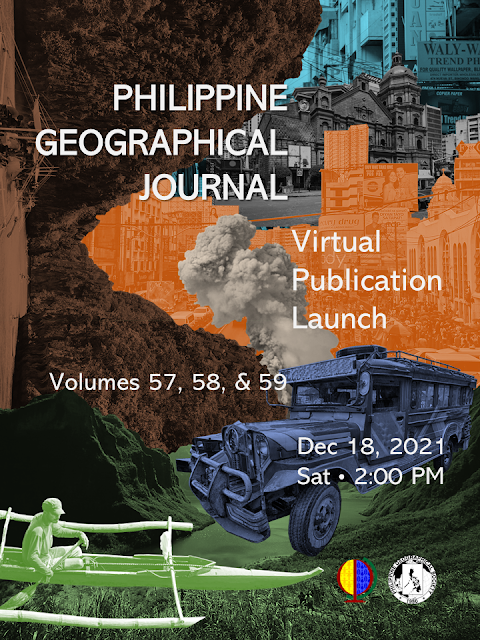
Philippine Geographical Journal Launches Volumes 57, 58 & 59

Is it possible to bring the dormant to life? 

Maybe if we're talking volcanoes, winter seeds, the underground life of cicadas, hibernating Ursus Linnaeus, and yes, the 'sleeping' issues of the Philippine Geographical Journal. 

PGJ started in 1953 -- a few years after the Philippine Geographical Society (PGS) was born -- and it kept on publishing articles that were either straight-up physical geography or with a broadly human-environment slant. But like most disciplines,  Geography evolved through the decades. It did not forget the early tradition of quantification, the fluvial domains, synoptic climatology and area studies, but has forged on to challenge definitions of the rural and urban, questioning the natural in 'natural disasters, and even make a case why moving images have inherently spatial dimensions. Perhaps the articles themselves reflected the discipline's various foci and trajectories as influenced by local and local-adjacent geographers. Some of us even question the idea of 'local'. After all, 'local' is also a social construction, no?


It is with pride that we invite you to the launch of PGJ issues that should have been released a long time ago if not for diminished financial resources and a host of other things that are too various to specify. But a resolute decision to bring back what were started in 1953 by pre- and post-war geographers is always strong. So here we are.

On Saturday, 18 December 2021, a PGJ Launch is happening at 2:00PM where volumes 57, 58, and 59 will make their debut. So come and celebrate with us. 

The themes are ostensibly on cultural geographies (Volume 57), disaster studies (Volume 58), and urban geographies (Volume 59) but they are also critical expansions and provocative iterations of these themes. 

So geographers and allies of geography, come on, come on. To participate, register using this link: https://tinyurl.com/yev46btw

This PGJ Launch is co-sponsored by the UP Department of Geography.

12 September 2018

Department of Geography showcases DRRM Initiatives in 2018 UP Katatagan Fair


By Yany Lopez


The Department of Geography shared its initiatives towards disaster risk reduction and management (DRRM) at the UP Katatagan Fair. The Fair was held on September 10, 2018. It was organized by the UP Padayon Public Service Office.

Assistant Professor Emmanuel Garcia represented the Department through describing the various DRRM initiatives undertaken through its Geography 192 (Field Methods in Geography) classes Field School classes. Prof. Garcia highlighted Participatory Three-Dimensional Mapping (P3DM) projects conducted by students and faculty members in close coordination with community, local government units and NGOs. 

Prof. Garcia's also showed results of the coordinated efforts between the Deparment of Geogrpahy and  the Catholic Relief Services towards mapping building footprints in selected municipalities of Rizal.  

The UP Katatagan Fair was a one-day outdoor event that featured booths and presentations towards DRRM awareness of the UP Commmunity.  Find the Facebook Page of the UP Public Service Office here (Link https://www.facebook.com/UPpublicservice/).

02 July 2011

The Department has moved to a NEW site


The Department has moved to a new site, not physically (yet) but virtually.  Finally, the Department has revised and updated its website.
   
The new website aims to acquaint prospective students regarding the discipline and its programs.  The site’s scrolling images show some of the possibilities that a geographer could do.  Therefore, we invite you to check its pages and discover what is in store for those who may choose to become geography majors.  

Click and surf the site and learn more about the Department as an institution and its people.   It is also a resource site for the Department’s students, academic and administrative staff with its downloadable forms and links that UP geography majors frequently visit. 

A unique feature in the website is the map of the field sites of the Department’s field classes done through the years.  It does not only show the places where UP geography students have visited but also the contributions they have made to the communities.  The research outputs of these fieldworks showcase the extension services the Department offers.  This proves and shows that the Department is practicing the University’s tradition of giving back to the people.

Welcome to the new Department Website and discover more by exploring http://www.geog.upd.edu.ph/

If you happen to find any typographical errors, missing names or links please feel free to send us your suggested corrections and comments at our new email address: geography@up.edu.ph