Showing posts with label disaster. Show all posts

15 June 2025

Heo/Geo Lecture Series 2025-06: Joycel Dabalos on the literary imagination of disaster

How does fiction imagine a disaster? How does the imagined disaster disturb/redefine the Filipino concept of family? 


For the sixth Heo/Geo Lecture for 2025, Joycel Vincent Dabalos' talk titled Rain and River: How Fiction Imagines Disaster and Disappearance, shares how he creatively wrote his two young adult stories populated with Filipino characters dealing with the wrath of disaster while carrying their distinct (yet playful) Filipino family identities. The lecture which is co-presented by the UP Department of Geography and the Philippine Geographical Society (PGS) will include his writing politics—how he perceives tangible world and how his stories offer an alternative world. The talk will take place via Zoom on Friday, 20 June 2025 at 5:30PM.


Joycel Vincent V. Dabalos is a creative writer and literature educator. He penned "Kulimlim: Mga Imahen ng Paglaho" (2024) and "Heterotopic Dissidences" (2025). He is currently completing his PhD in Philippine Studies (Presidential Scholarship Grant) at the University of the Philippines-Diliman. He obtained his MA in Language and Literature from De La Salle University Manila. He is a fellow for maikling kuwento of the 12th Palihang Rogelio Sicat held at UP Los Baños. His poems have been featured in the Heights Ateneo, Kawing Journal, and panitikan.ph. His latest poem "The Long History of Virus" will be published in ANI 42, the literary journal of the Cultural Center of the Philippines. His research interests span heterotopic spaces, queer disaster, narrative theory, literary ecology, and creative writing.


Jointly presented by the Geographies of Disasters and Hazards (G-DASH) and Media, Literary Geographies and Geohumanities (MELANGE) research clusters of the UP Department of Geography, the talk satisfies the Social Development Goals of United Nations Sustainable Development especially #4 (Quality Education) and #15 (Life on Land). 


The Heo/Geo Lecture Series started out as the Brown Bag Lecture Series/Geography Webbynar but later rebranded as Heo/Geo to accommodate the multiple ways Geografia/Heograpiya is perceived. The lecture series in its present iteration serves and provides a space where practical, discursive and embodied discussions and performativities from academic geographers, geography-adjacent scholars, practitioners and civil society can come together and share ideas to popularise the discipline of geography.


To register for the lecture, please click this link to participate.


04 October 2024

Heo/Geo Lecture Series 2024-10: Liberty de Rivera on interrogating the rhetoric of resilience building

What comprises the right education for Disaster Risk Reduction (DRR)? This oft-asked question has long intrigued educators and field practitioners when viewing what builds a culture of safety and resilience among society's vulnerable sectors. 

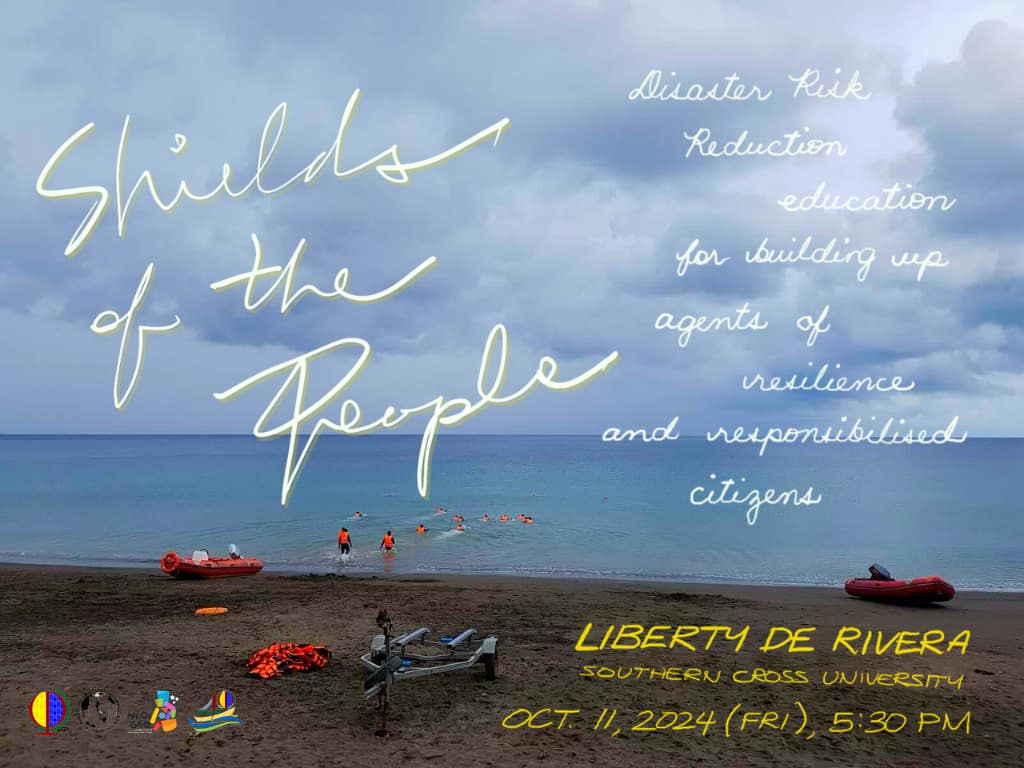
For the latest paper presentation of the Heo/Geo Lecture Series for 2024, DRR will be spotlit as a global policy initiative to build resilience in hazards-exposed communities. Sponsored jointly by the UP Department of Geography and the Philippine Geographical Society (PGS) the Heo/Geo Lecture Series presents ‘Shields of the people’: Disaster Risk Reduction education for building up agents of resilience and responsibilised citizens to be presented by Dr Liberty de Rivera on Friday, 11 October 2024 at 5:30PM Philippine time UTC+8 / 7:30PM AEST UTC+10). 


For this presentation, Dr de Rivera interrogates the rhetoric of resilience building through education by investigating its contrasting features as an agentic concept and a responsibilising device. Through an ethnographic reading of DRR education programmes in Aparri town in the Philippines, she will illustrate how resilience as a polyvalent construct creates a double-bind of creating spaces for education actors and learners; participation and empowerment while legitimising patterns of deflection of responsibilities. Dr de Rivera centres the analysis on the metaphorical reference of students as Salaknib Dagiti Tattao, or shields of the people, and the designation of teachers as disaster responders to demonstrate how emerging labels and expectations about resilient citizenship must be reflexively developed and critically enacted. Inherent within these programmes are features that might depoliticise disasters and overshadow the need to uphold accountability and responsibility. 

Dr Liberty Pascua de Rivera is Vice-Chancellor Research Fellow at the Faculty of Education of Southern Cross University. Her research interests include analysing and evaluating policies and their implementation in the areas of education for sustainable development, climate change, and disaster risk reduction. Central to her research is the idea of cognitive justice—what, or whose knowledge, is emphasised, neglected, and minoritised in processes of policy cascade.

Liberty obtained her BA in Communication Research degree from the UP College of Mass Communication and her Master of Development Studies and PhD from the University of Sydney. Liberty has taught, conducted research, and engaged in development work in Singapore, the Philippines, Vanuatu, and Australia. She is the treasurer of the Oceania Comparative and International Education Society (OCIES) where she also co-leads the New and Emerging Researchers of OCIES. Liberty is an Associate Editor of the International Research in Geographical and Environmental Education (IRGEE) journal. Liberty is from the province of Apayao. She is the mother to two-year-old Kappia and partner to Ryan.

The Heo/Geo Lecture Series is a space to share and exchange ideas on a wide variety of geographical topics that intersect methodologies, discourses, technologies, pedagogies, and practices. Faculty, students, alumni and local and foreign geography and geography-adjacent researchers delivered various presentations in previous academic years fulfilling one of the Department’s mission: to popularize geography as an academic discipline through research and practice. 

This presentation is sponsored through Geographies of Disasters and Hazards (G-DASH), and the Human Geography (HuG) and Media, Literary Geographies, and Geohumanities (MELANGE) research groups of the UP Diliman Department of Geography and in line with the UN Sustainable Development Goal #3 (Good health and well-being) and #4 (Quality education). 

To participate in the talk, click this link to register: https://bit.ly/3zLBSMx

30 May 2023

Heo/Geo Lecture Series 2023-09: Keith Landicho on averting and outsmarting disasters

Can disasters be averted and mitigated with the judicious help of a network of tools and workflows? Find out for this month's Heo/Geo Lecture Series.

It is said that the physical conditions and existing socioeconomic vulnerability of a geographical environment combined with the threat of a hazard, determines the way that disasters are formed—the spatial extent of impact and the scale of losses. This relationship between the geographical environment and disasters may be perceived as cyclically causal in nature but there is more to it than meets the eye. This is due to the development of disaster risk reduction and management practices in the discipline of geography where it has been widely used. Additionally, there is an indication that the geographical environment, both its physical and social elements, has adapted through natural as well as anthropogenic processes. These practices are manifested through tools, workflows, and linkages that collectively aim to mitigate the impacts of disasters and anchored in the study of places and the relationships between people and their environments.


For the ninth Heo/Geo Lecture Series, the UP Department of Geography and the Philippine Geographical Society proudly present a talk from geography alumnus Keith Landicho. Taking place via Zoom on Friday, the 2nd of June 2023 at 5:00PM, the lecture is entitled Outsmarting Disasters: Geographically-rooted Tools, Workflows, and Linkages. Keith's presentation features examples and applications of tools, workflows, and linkages utilized in the ASEAN humanitarian sphere to reduce disaster, hence a step towards outsmarting disasters.

A BS Geography graduate of UP Diliman, Keith Paolo C. Landicho is a Disaster Monitoring and Analysis Officer at the ASEAN Coordinating Centre for Humanitarian Assistance on disaster management (AHA Centre) and is a certified Security Risk Management Professional - Country Level contributing to the reduction of disaster losses in the ASEAN region. Keith’s seven (7) years of professional experience comprises work in the fields of disaster risk reduction and management, environmental conservation, urban heat island studies, and humanitarian response. Specializing in geospatial data analytics, Keith uses that experience to ensure that crucial knowledge and information from disasters, research, as well as policies, connects to the community, its people, and its support systems.

This Heo/Geo Lecture Series not only features speakers from the academe but also field-based practitioners working for civil society, industry, popular education, and for multiple community advocacies. This presentation is part of the many activities the UP Department of Geography and Philippine Geographical Society lined up in observance of the 40th anniversary of the discipline of geography's institution as a separate and standalone degree-granting department -- the only one of its kind in the whole archipelago.

To participate for this talk, please register through this link. Or you can click this link as well - https://up-edu.zoom.us/meeting/register/tJwtfuGqrDoqEtPKvJPNp3XE6G_QltF54kG5#/registration

02 October 2021

Bryan Mariano on deploying social network analysis in understanding Typhoon Ketsana's socio-spatial impacts in 2009

Bryan Mariano and co-authors ponder at the adaptive knowledge sharing in the context of disaster such as Typhoon Ketsana that pillaged Marikina City in 2009. 

The scourge of disasters which brought unparalleled scale of damages demand new strategies that would effectively reduce risks and uncertainties in complex organizational environments. Informed by complexity theory and social network analysis, the chapter takes the case of Marikina City, Philippines and examines how adaptive knowledge sharing strategies can strengthen institutional adaptive capacity in disaster risk reduction and management.


Written in conjunction with Winifredo Dagli and Giuseppe Cirella, Mariano's book chapter entitled Adaptive Knowledge Sharing in Turbulent Times: Urban Disaster Risk and Knowledge Management is due in early 2022 as part of the book "Human Settlements: Urbanization, Smart Sector Development, and Future Outlook" by Springer. 

Bryan Mariano is an MS Geography student whose research interests range from environmental humanities to critical forest studies.

10 July 2021

PGS Lecture Series 2021-09: John Ceffrey Eligue on vulnerabilities of the fisherfolk and farmer communities in Camotes islands

Disaster studies oftentimes focus on large-scale and macro-level physical and natural hazards and how environments are impacted in the aftermath of disasters. Fewer studies spotlight on what van Voorst et al (2015) term as “everyday hazards,” where human subjects’ experience and encounter with environmental stresses are given particular focus. 

Sponsored by the Philippine Geographical Society (PGS) through the PGS Lecture Series, John Ceffrey Eligue’s talk will illustrate these “everyday hazards” and how protracted daily neglect leads to fragile livelihoods for those who are already exposed to natural hazards. Prof Eligue’s presentation entitled Purok, Pook, at Panganib: stories in times of kalisod and managing everyday risks in the Camotes Islands will showcase the use of a more place-based approach in identifying patterns of risk perception and coping strategies of people living with slow-onset hazards in an island community of Camotes. Deploying kalisod (Visayan for hardship) as an analytic, the talk gives equal importance to stories gleaned from the farmers and fisherfolk in the island using a socio-spatial approach. The study attests that vulnerability is not static and social bonding is necessary in coping during times of kalisod.

Prof Eligue is a faculty member of the Department of Community and Environmental Resource Planning, at the College of Human Ecology of the University of the Philippines Los Baños. He teaches courses on human ecology, human settlements, and planning theory. Prof Eligue served as research associate for various land and water use planning projects and foreign-assisted programs doing field works across the country prior to his employment as an assistant professor at UPLB. 


This presentation happens on 17 July (Saturday) at 2:00PM. If you wish to attend and participate, register through this link.

The UP Department of Geography is a co-sponsor of this event through the Human Geography, and Geographies of Disasters and Hazards research clusters. 

19 May 2021

PGS Lecture Series 2021-07: Soledad Dalisay on the role of cultural memory in disaster risk resilience

"Disaster memory is a strong political process: it modifies the perceptions of inhabitants ... in a powerful, emotional way," said Antoine le Blanc in 2012. Maria Kyriakidou extends this cultural logic by implicating the power of uncomfortable memory, or as she says "... there is a moral hierarchy in the way viewers remember distant suffering ... [and] constructed through the intertwined processes of remembering and forgetting" (2014, 1474).

In the latest Philippine Geographical Society's PGS Lecture Series, Dr Soledad Natalia Dalisay focuses on the functions of cultural memory in the context of disaster resilience. Entitled Cultural Memory for Disaster Risk Reduction, the talk delves into the importance of remembering disasters and the ways in which societies remember. In this lecture, cultural memory will be defined and expanded and some of the ways in which it is expressed in both built heritage and living heritage are presented. Emphasising living heritage, examples are provided in the domains of local knowledge and social practices. Lastly, issues in remembering are discussed and future directions for scholarly work on cultural memory and disasters are forwarded.


Dr Soledad Dalisay is Professor at the UP Department of Anthropology. Her research interests lie at the nexus of cultural ecologies of health, anthropologies of disaster, and gender and sexuality. She served as the first faculty coordinator of the UP Office of Anti-Sexual Harassment (OASH) for six years (2008-2014). Her latest publication is entitled Intangible Cultural Heritage which is part of the International Research Centre for Intangible Cultural Heritage in the Asia Pacific Region (IRCI) under the auspices of UNESCO.

The talk is on May 28 (Friday) at 6:00PM. Check this link to register for the lecture. https://bit.ly/3oB7wST

This talk is jointly sponsored by the UP Department of Geography and the UP Department of Anthropology.

10 April 2021

PGS Lecture Series 2021-04: Emmanuel Garcia on participatory 3D mapping and community management

In this Philippine Geographical Society (PGS) Lecture Series, PGS President Emmanuel Garcia, EnP discusses the role of Participatory 3-Dimensional Mapping (P3DM) in integrating indigenous and local geographical knowledge with data on topography to create stand-alone, scaled, and georeferenced 3D models useful in Disaster Risk Reduction and Management (DRRM).


Emmanuel Garcia is an assistant professor at the UP Department of Geography. A geographer and licensed environmental planner, he specializes in community-based disaster risk reduction and management and land-use planning. His research interests include heritage mapping and transport and development.

This talk happens on April 14, 2021 (Wednesday) at 6:00 PM. Click this link to register for the talk: https://bit.ly/2Q89soX

Asst. Prof. Garcia's lecture is co-sponsored by the UP Department of Geography.

26 February 2020

Documentary on Disaster, Resilience and Survival on March 2 (Monday)

The U.P. Department of Geography, in partnership with the Japan Foundation and Toshiba International Foundation, spearheads the screening of Life Goes On -- a documentary about the geostories told by survivors from the Great East Japan earthquake and tsunami in 2011. The screening takes place on Monday, March 2, 2020 at 1:00PM in PH 207 with a Q&A talkback session with Director Yoon Mia and cast. 


Life Goes On chronicles the lives of ordinary people's struggle to rebuild themselves six years after the 2011 earthquake and tsunami. This documentary reveals the everyday realities of the Tohoku region and of Japan today, through the hidden stories of the people living in the affected area. 

A workshop to be facilitated by Director Yoon Mia will follow after the screening, at 3:00pm. This will be held in Pavilion 2248. 

For more information about the documentary, check this link.  

To view the trailer, click this link.  

This event is sponsored by three research clusters of the U.P. Department of Geography:  Geographies of Disasters and Hazards, Environment and Development Geographies (EDGE) and Geographies of Media (GeM).

25 September 2019

Geography Brown Bag Colloquium Series: Power, Prestige, and Forgotten Values: A Disaster Studies Manifesto


by Febbie Casabuena

Dr. Jake Cadag talked about the pitfalls of social stratification and power relations in the practice of disaster studies in the second installment of the Brown Bag Colloquium Series for the semester. Titled 'Power, Prestige, and Forgotten Values: A Disaster Studies Manifesto', Jake discussed how social hierarchy plays a part in the policy-making and actions undertaken in many aspects and stages of disaster. According to Dr. Cadag, experts' knowledge and decisions are placed on a higher regard than those of the locals, resulting to the disempowerment of the vulnerable others. Unjust power relations in disaster studies also pose an intellectual problem stemming from the neglect of a form of knowledge from a group perceived to be socially inferior. This form of knowledge would have been most helpful as it is rooted in the local's experiences.


Dr. Cadag also noted that it is often that communities involved in disaster studies research rarely have access on the results of the research itself. This is due to research outputs not being translated into the community's vernacular language, inability of researchers to return and report their findings on the community itself, and lack of effort from the local government units to read and disseminate the findings of the researches. Many researchers and academicians genuinely hope that what they do in the University (e.g. research) would somehow benefit the society (e.g. reduce risk through research). But how many of the research findings found their way to those who actually need them (e.g. local people or authorities in the communities)? Disaster studies researchers seem to be more concerned of the individual and institutional prestige and power that they could earn from doing research. And this is the forgotten value – disaster studies researchers forget that their research matter because they are useful in disaster risk reduction (e.g. save and protect people’s lives especially the most vulnerable people). In line with this, Jake and many disaster studies researchers and scholars have committed in an effort to be more accountable to local people and stakeholders and foster collaboration in disaster studies.

You may access and support the petition through this link: https://www.ipetitions.com/petition/power-prestige-forgotten-values-a-disaster. Credit should be given to Dr. JC Gaillard of the University of Auckland, NZ and many scholars of disaster studies for leading this petition. 

02 September 2019

Geography Colloquium #2 (2019-2020): Jake Cadag on Disaster Studies Manifesto on September 11, 2019.

For the second Geography Brown Bag Colloquium lecture, Dr Jake Cadag will give a talk entitled Power, Prestige & Forgotten Values: A Disaster Studies Manifesto. It will be held in PAV 2248, on September 11, 2019 (Wednesday) at 4:00PM.

Please check out the petition here.

01 March 2019

Filipino and Japanese Youth Exchange Disaster Management Practices in "Koukan"


by: Geomajie Core Group 
Edited by: UP Department of Geography

Participants of the forum take a group photo

On February 15, 2019, the Geomajie core group and the Junior Philippine Geographical Society - UP Diliman, in partnership with the Department of Geography, held a forum on Disaster Management entitled Kouken: Cultural Exchange on Disaster Management. Koukan is Japanese for Exchange.

Ms. Dominique Amorsolo, Instructor of Geography, shares her insights.
The forum focused on how disaster management is handled in the Philippines and Japan. Mr. Youji Ishii, Ms. Moeri Toda, and Ms. Yukiko Nakano from CityNET Youth Japan shared insights and knowledge on how Japan responds to disasters. They presenter different infrastructure projects of the Japanese government, such as underground flood tunnels and the awareness campaigns that are undertaken, such as the Iza! Kaeru Caravan. The caravan is aimed at educating young children and their families about disaster prevention through fun ways. The caravan was conducted in recent visits to Payatas.


Mr. Joel Licup, the Geography Department Representative, presented the different agencies involved in disaster risk reduction in the Philippines. He high lighted that in the past. poverty and insufficient government support have hindered disaster awareness Gradually campaigns conducted by local governments of citizens have increased disaster prevention awareness in the Philippines.

Participants share insights on disaster prevention and awareness strategies of Japan and Philippines.

An open forum gave attendees the opportunity to give insights. The activity ended with a dinner hosted by the Department of Geography.