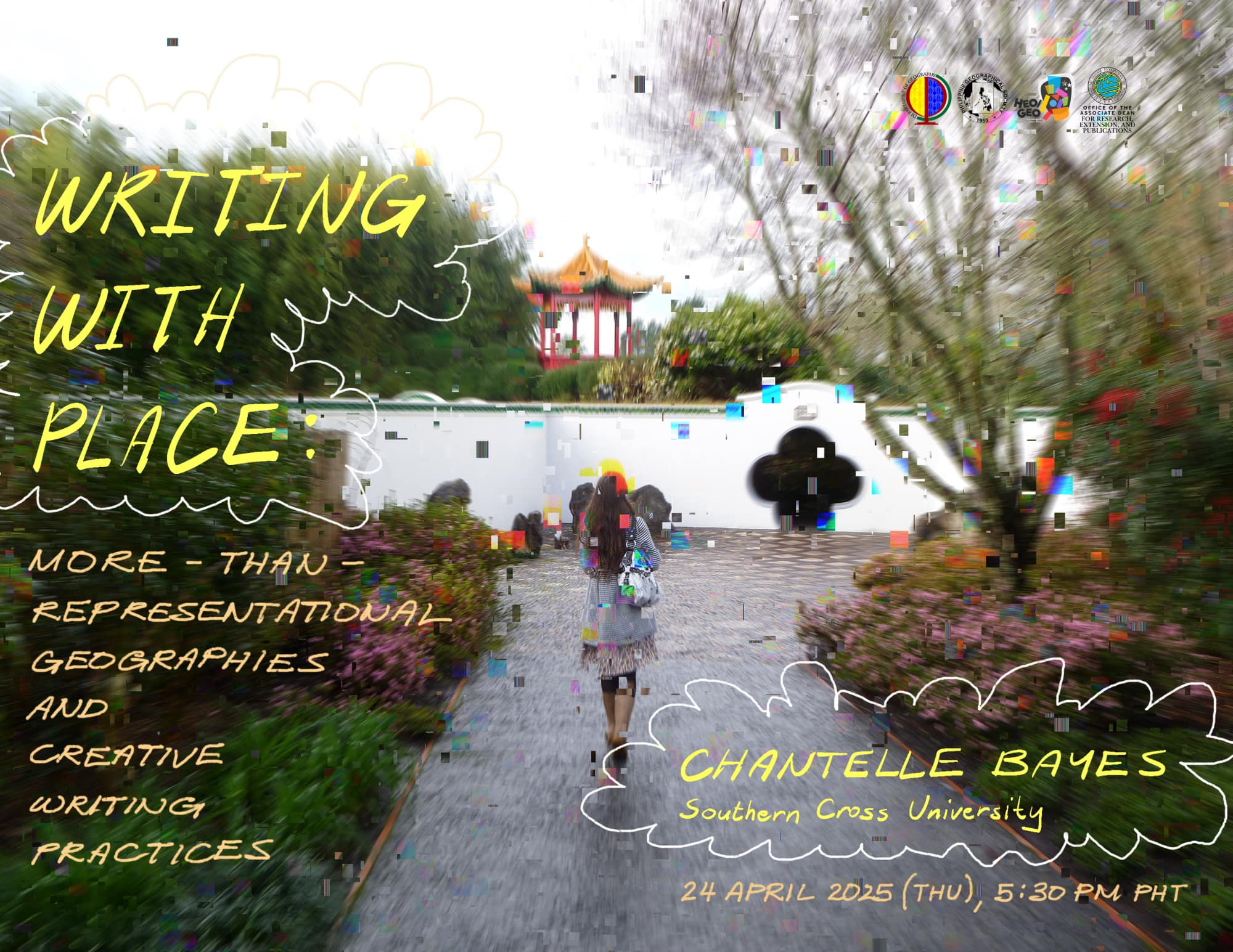
For the 4th Heo/Geo Lecture Series for 2025, that question will be discussed by Dr Chantelle Bayes who will give a talk entitled Writing with Place: More-than-representational Geographies and Creative Writing Practices on Thursday, 24 April 2025, at 5:30PM PHT (7:30PM AEST) via Zoom. More-than-representational geographies are the non-tangible aspects of geographies such as affects, practices, and processes. Dr Bayes' talk considers the relationships between practices of research-creation and geographies.
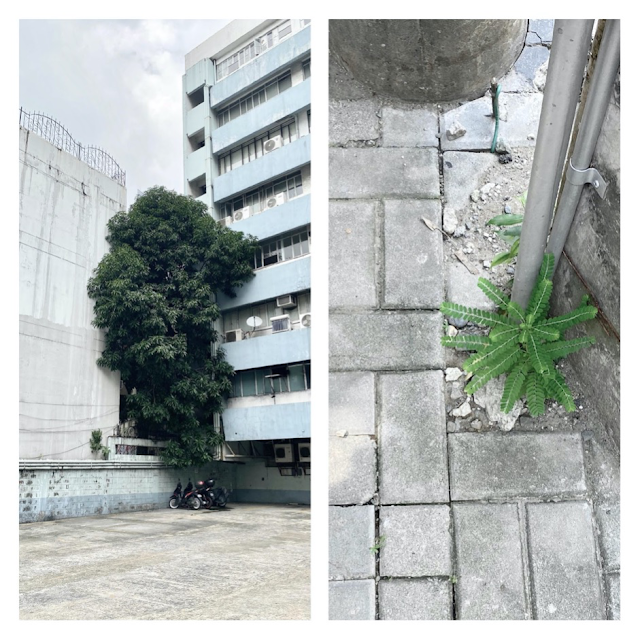
It’s well known that many writers, researchers and creatives have moments of inspiration while undertaking some sort of mundane activity from walking and commuting to cleaning. Knowing this, many writers and researchers have sought to engage with place as an intentional practice whereby they undertake activities such as walking to facilitate their thinking and making. These creative practices also inform our understanding of cultural geographies by diffracting experiences of place including the mundane, the intangible, the affective and the embodied.
In Dr Bayes' research, writers most often talked about four activities in place that formed part of their writing process: walking, swimming, surfing, and gardening. Walking was by far the most noted activity with a deep history in connection with storytelling. The two main processes at work during such activities are firstly a close attention to place, and secondly an inattentive engagement with place through day-dreaming, creative thinking, thought making, and editing. These two processes are not always separate but may occur simultaneously, or like a camera lens drifting in and out between the two. Being in place and engaging with local geographies impacted the writing process in several ways by bringing attention to the ways that places, authors and texts are entangled in relationships of care, damage, or disruption. Dr Bayes will discuss anecdotes from several writers who use place-based creative practices so we can consider what this does to our shared understanding of geographies.
Dr Chantelle Bayes is a creative writer, researcher and educator living in Queensland, Australia. Her research areas are the environmental humanities, arts-based environmental education, contemporary literature and creative writing practices. Her book Reimagining Urban Nature: Literary Imaginaries for Posthuman Cities came out with Liverpool University Press in 2023. She is currently working at Southern Cross University as a postdoctoral research fellow on the ARC funded project 'Climate Country: Advancing Child and Youth-Led Climate Change Education with Country'.
The Heo/Geo Lecture Series is a joint project of the University of the Philippines Department of Geography and the Philippine Geographical Society (PGS). The Lecture Series is a monthly resource talk / lecture given by academic geographers, geography-adjacent scholars, practitioners working in geospatial industries, and partners working in multiple publics based locally and abroad. The talk ranges from the sharing of research findings, pedagogical practices, and field-based experiences. This month's Heo/Geo Lecture Series is facilitated by two research groups at the UP Department of Geography: Human Geography (HUG) and Media, Literary Geographies, and Geohumanities (MELANGE), and in line with the UN Sustainable Development Goals #4 (Quality Education), and #15 (Life on Land).
To participate in the lecture, click this link to join: https://tinyurl.com/2dvuj8du