Showing posts with label colloquium. Show all posts

10 November 2020

Geography Webbynar #4 (2020-2021): Laura Brewington on ecological security and climate change in the Pacific

CANCELLED

We will announce the new date of the webinar talk.

For the fourth Geography Webbynar this semester, the UP Department of Geography cordially welcomes Dr Laura Brewington from The East-West Center at the University of Hawai'i as resource speaker. Dr Brewington's talk -- Climate Change and Ecological Security in the Pacific Islands is culled from various research and consultative meetings that she participated in the Pacific islands. 

The talk is on Friday, November 13, 2020 at 3:00PM (Manila) and 6:00PM (Sydney). The Zoom details are as follows: 

Topic: Geography Webbynar 04: Dr Laura Brewington

Time: Nov 13, 2020 03:00 PM Singapore

https://up-edu.zoom.us/j/85677884413

Meeting ID: 856 7788 4413

Passcode: Porpoise


05 October 2020

Geography Webbynar #2 (2020-2021): Sarah Raymundo on indigenous knowledge and sustainable futures

For the second Geography Webinar Colloquium this semester, the UP Department of Geography welcomes Prof Sarah Raymundo, director of the UP Center for International Studies. She does organizing work for the International League of Peoples' Struggle (ILPS) and BAYAN (New Patriotic Alliance), associate editor of Journal of Labor and Society, and Interface: Journal of and for Social Movements. Her talk is entitled Making Space for Indigenous Knowledge, Sustainabilities, and Futures. 

The event is happening on 14th October (Wednesday) at 7:00PM (PHT, GMT+8). 

Zoom details can be found below:

Time: Oct 14, 2020 07:00 PM Asia/Manila

https://up-edu.zoom.us/j/89298989259

Meeting ID: 892 9898 9259

Passcode: Porpoise 


24 September 2020

Geography Webbynar #1 (2020-2021): Emerson Lorenzo on Water/Shipping Transportation in the Philippines

To kick off this semester/schoolyear's Geography Colloquium Series (rebranded as Geography Webbynar for these unusual times), the Department welcomes Emerson Lorenzo as the first speaker. A former faculty/lecturer at UPD-Geography and administrator of Maritime Industry Authority (MARINA), Prof Lorenzo serves as transport consultant in various agencies. His talk culls from his vast experiences at MARINA and in teaching economic geographies at UP Diliman. The talk is on Wednesday, 30th September 2020 at 7:00PM (PST; GMT+8).

Zoom details
Topic: 01 Geography Webbynar 9/30/2020 - Emerson Lorenzo
Time: Sep 30, 2020 07:00 PM Singapore
Meeting ID: 952 8437 6516
Passcode: Porpoise


08 March 2020

Geography Colloquium #13 (2019-2020): Sarah Raymundo on activist mappings and epistemic shifts in indigenous knowledge

THIS EVENT WAS CANCELLED DUE TO THE CORONAVIRUS LOCKDOWN

Prof Sarah Raymundo, director of the UP-Center for International Studies delivers a presentation entitled Making Space for Indigenous Knowledge, Sustainabilities, and Futures on Friday, March 13th 2020 at 4:00PM in Pavilion 2248. This Geography Colloquium Series talk is sponsored by the Human Geography (HuG) research cluster of UP Department of Geography. 

Prof Raymundo is engaged in activist work in BAYAN (The New Patriotic Alliance), the International League of Peoples’ Struggles, and Chair of the Philippines-Bolivarian Venezuela Friendship Association. She is a member of the Editorial Board of the Journal for Labor and Society (LANDS) and Interface: Journal of/and for Social Movements. She writes regularly for Bulatlat -- the Philippines' longest-running alternative news website. 


03 March 2020

Geography Colloquium #12 (2019-2020): Herman Kraft on Southeast Asian security and geopolitics

Prof Herman Kraft, chairperson of the UP Department of Political Science will give a talk for the Geography Colloquium Series entitled ASEAN and Southeast Asian Security: A Geopolitical Analysis, on Friday, March 6, 2020 at 4:00PM in Pavilion 2248.

Professor Kraft  is a convenor of the Strategic Studies Program of the UP Center for Integrative and Development Studies (CIDS). He has been working on and published articles and book chapters on issues concerning ASEAN, regional security in Southeast Asia, security sector reform, and intra-state conflict in the Philippines. His recent publications on ASEAN include: “Great Power Dynamics and the Waning of ASEAN Centrality in Regional Security” (2017), and “The Ebb and Flow of Civil Society Involvement in ASEAN” (2017).*

This talk is sponsored by the Human Geography (HuG) research cluster.


* source: https://polisci.upd.edu.ph/faculty/kraft/

19 February 2020

Geography Colloquium #11 (2019-2020): Boris Michel and Johann Braun on the rise of right-wing populism in Germany

Dr Boris Michel and Dr Johann Braun from the Institut für Geographie of the Friedrich-Alexander-Universität Erlangen-Nürnberg will jointly give a talk for the Geography Colloquium Series. The lecture, entitled Political Geographies of Right-wing Politics and Populism in Germany, takes place on Monday, February 24, 2020 at 3:00PM in Pavilion 2248. This talk is sponsored by the Human Geography (HUG) research cluster.

Dr Michel's recent publication is on anti-semitism in German geography, while Dr Braun's latest is on Kotti and critical cartography (with Frederieke Westerheide).  


17 February 2020

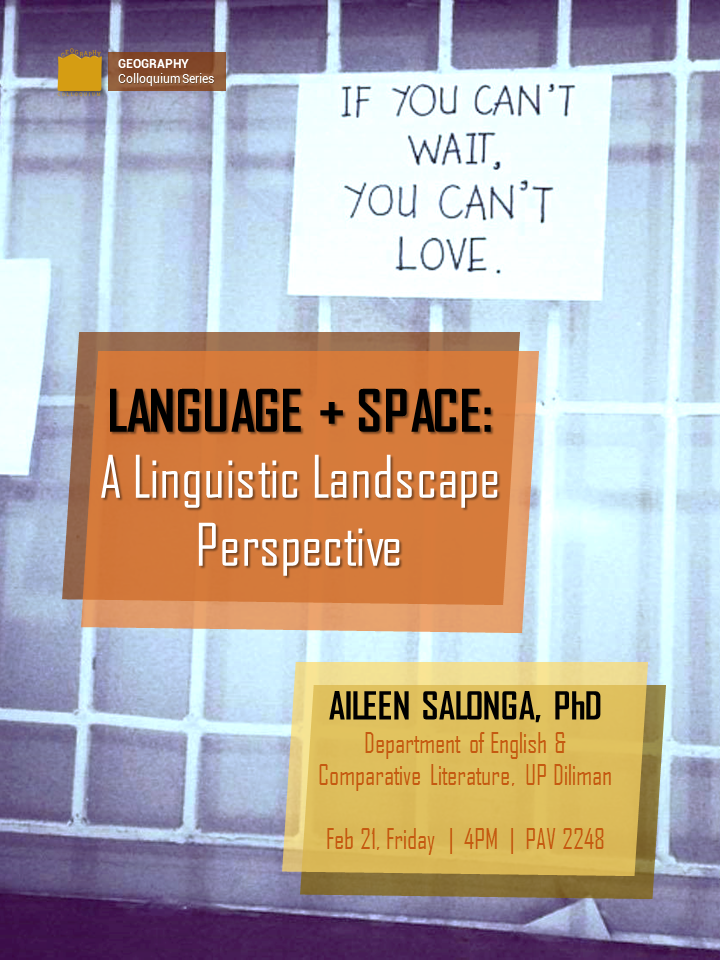
Geography Colloquium #10 (2019-2020): Aileen Salonga on linguistic landscapes for the Geography Colloquium Series

Dr Aileen Salonga from the UP-Department of English and Comparative Literature will speak on the territorialisation of language for the Geography Colloquium Series with a talk entitled Language + Space: A Linguistic Language Perspective on Friday, February 21, 2020 at 4:00PM in Pavilion #2248. This talk is sponsored by the UP Department of Geography through the Geographies of Media (GEM), and Human Geography (HUG) research clusters. 

Specialising in sociolinguistics, critical discourse studies, and rhetoric and social theory, Dr Salonga has published extensively on language and politics with intersection to and on decolonialism, mediated technologies, and communication practices among call centers.  Previously, Dr Salonga served as Associate Dean for Academic Affairs at the College of Arts and Letters of the University of the Philippines-Diliman. 


03 February 2020

Geography Colloquium #9 (2019-2020): Aaron Vicencio on sonic geographies of Ateneo Wild

Aaron Vicencio will speak on sonic geographies and acoustic ecologies of the urban wildlife at Ateneo de Manila University premises for the Geography Colloquium Series. Entitled From Hearing to Listening, the Sounds of Nature: Sonic Geographies of Ateneo Wild, the talk will be held on Friday, February 7 at 4:00PM in Pavilion 2248. This talk is sponsored by the Geographies of Media (GEM) Research Cluster.

Trained in psychology and human geography at the Ateneo de Manila and UP Diliman respectively, Vicencio's talk is part of the project that documents biophony for an immersive sound experience. This multi-partnered endeavor aims to map the frequency of seeing, hearing, and feeling nature. 


26 January 2020

Geography Colloquium #8 (2019-2020): Francis Hermoso on ludic geographies and hyperreal places through augmented realities

Francis Hermoso from the Center for Social Responsibility of the University of Asia & the Pacific opens this semester's Geography Colloquium Series. His talk is entitled Where's that Pokémon? Playful Mapping and Construction of Places in Games and Augmented Realities and will take place (pun intended) in Pavilion 2248 on Friday, January 31, 2020 at 4:00PM. This talk is sponsored by the Geographies of Media (GEM) Research Cluster.

A BS and MS Geography graduate of UP Diliman, Hermoso's talk is an extension of his masters thesis on ludic geographies focusing on Pokémon GO!


18 November 2019

Geography Colloquium #7 (2019-2020): Maria Celeste Hermida talks about living alone in various Philippine contexts

For the last colloquium lecture of the first semester 2019-2020, Prof Maria Celeste Hermida from the UPD Department of Geography will lecture on Living Alone in the Philippines on November 22 (Friday) at 4pm in Pavilion Room 2248.


07 November 2019

Geography Brown Bag Colloquium Series: Home unmaking and re-making among the urban poor within neoliberalism


For the fifth Geography Brown Bag Colloquium Series of the first semester, Dr. Chester Arcilla from UP Manila Department of Social Sciences discussed the politics of home among the urban poor. His lecture titled Home unmaking and re-making among the urban poor within neoliberalism discussed neoliberalism as complicit to the undoing of urban poor people’s homes.


The home is defined as physically incomplete. This specific definition goes beyond the concrete and tangible structure of what makes a dwelling place but also includes the “tactical and strategic process of negotiating different relationships from which new lives…can be built [and] is a much an everyday politics of citizenship.” In the same vein, home un-making is defined as more than the undoing of the physical materials that make up a home but also the destruction of its imaginary components. As Dr. Arcilla said: “the processual notion of home-(un/re)making enables a better understanding of urban poor lives within neoliberalism.” He cited the Sitio San Roque demolition in 2014 as a case study. The evictees were traced five years after in order to understand the process of their home-remaking through focus group discussions and ethnographically-inspired storytelling sessions.

The commodification of government housing projects is found to be unaffordable, undemocratic, and unsustainable. Due to the fact that the resettlement areas for displaced families are often deemed unlivable (situated away from their primary source of income), the dual housing crisis entails an increasing trend of unmet housing needs while having low-occupancies in existing socialized housing stock. The displaced would eventually find their way back to the slums to start the process of home-remaking. In some cases, the relocation units are even sold off to provide funds for travel, ironically wielding the “very instrument that the state uses to displace the urban poor—socialized housing […] burrow back into the city.”


Once reinstated, the construction of a dwelling place is done incrementally. As Dr. Arcilla remarked: “Materials and design depends on the available finance and the level of state surveillance against encroachment--made of recycled, flimsy and light materials assembled within the fastest possible time and with least cost.” The parts of a home are spatially segregated (sleeping, cooking, eating, bathing and living areas) to increase mobility and security as an active response to the continuous “clearing” operations done on the area.

“[The] blighted, dirty, fire-prone’ squatter housing are in actuality homes-in-construction of the poor.”

* Quoted statements are taken from Dr. Chester Arcilla’s presentation

30 October 2019

Geography Colloquium #6 (2019-2020): Dominique Amorsolo on the geographical histories of the Lower Abra River

Prof Dominique Sasha Amorsolo from the UPD Department of Geography and who is a graduate student at the Institute of Environmental Science and Meteorology will present her research entitled A Geo-Historical Tale of a River: The Case of Lower Abra River on November 8 (Friday) at 4:00PM in Pavilion 2248.


21 October 2019

Geography Brown Bag Colloquium Series: The Role of Geography in Counter-Insurgency Warfare: The Philippine - American War, 1899 - 1902


by: Febbie Casabuena

         For the latest installment of the Brown Bag Colloquium, the Department of Geography invited Dr. William Holden from the Department of Geography of the University of Calgary. Dr. Holden talked about how geography affects the outcome of insurgency or rather, counter-insurgency warfare.


          Dr. Holden noted how terrain is often seen as something that favors the insurgents. In his paper "The Role of Geography in Counter-Insurgency Warfare: The Philippine - American War, 1899 -  1902", he discussed how the Philippine terrain gave American government an advantage in its counter-insurgency efforts in the provinces of Ilocos Norte, Ilocos Sur, Batangas, Marinduque, Samar, and Cebu. Due to the archipelagic nature of the country, the Americans managed to compartmentalize the provinces with insurgencies by controlling the seas to control the movement of the insurgents and the influx of goods and weaponry available to the resistance. Fragmentation of the islands also led to the fragmentation of the country's human geography which the Americans utilized to their advantage, particularly using the resentment of other ethnic groups under Tagalog insurgent leaders to sow distrust and weaken the resistance.  Americans also placed garrisons in communities which afforded them permanent control of the area as well as separation of the locals from the insurgents, effectively cutting off the resistances' supplies and intelligence reports. Furthermore, the Americans also employed medical warfare which cut down the local population, thereby further weakening the insurgency in the provinces.

          Dr. Holden finished his lecture with how history is repeating itself - or at least, how "we are moving towards the age of insurgencies", especially of the marginalized. He listed three things that could drive this: [1] the vast inequalities occurring under neoliberal capitalism; [2] environmental degradation, particularly climate change; and [3] the culture of militarization.

18 October 2019

Geography Brown Bag Colloquium Series: Rescaling Nomosphere for Legal Geography Studies in the Philippines


Prof. Reidan M. Pawilen from the Department of Social Sciences, UP Los Baños is the keynote speaker for the third Geography Brown Bag Colloquium Series for the first semester. His discussion, Rescaling Nomosphere for Legal Geography Studies in the Philippines, highlighted legal geography as an emerging sub-discipline in human geography.


Legal geography deals with how people and places co-consitute the world. It draws from the “premise that the legal co-creates the spatial and the social, while the social and the spatial co-create the legal.” While there have been multitudes of studies concerning legal geography from the Global North, research on the subject matter from the Global South remain few and far between. This study serves as an active effort to enrich legal geography research in the Global South, giving emphasis on nuances that cannot be captured through generalizations obtained from the Global North alone. Using the framework nomosphere developed by Delaney investigates the “cultural-material environs that are constituted by the reciprocal materialization of ‘the legal’, the legal signification of the ‘socio-spatial’, and the practical performative engagements through which such constitutive moments happen and unfold.” In his study, Pawilen utilized the Bodong Indigenous Allied Group, Inc. (BIAG) as a case study for this conceptual framework.

Prof. Pawilen walked the audience through Bodong functions as an alternative dispute resolution method (ADR). The lack of representation for both Indigenous Peoples and IP rights in the country’s legal system led to a need to establish and reorganize to a more “formal” institution that the state could easily recognize. For the Bodong, it was their reformation as BIAG. BIAG’s method of enacting justice makes use of the group’s numbers to occupy a certain space, most often turning the home of the accused as a trial court, “to disrupt and neutralize the daily activities of the area and force a mediation between aggrieved parties.” The only limit given to these activities of enacting justice is that they do not violate any currently existing human right. Their means and reach are more flexible that the traditional legal process and can easily be adjusted on a case to case basis.

These IP institutions for justice such as the BIAG continuously challenge not only state authority and state laws but also other neighboring IP communities. One of the consequences of reorganizing such systems is that it exposed certain tensions between differing communities most especially in terms of jurisdiction. Given these circumstances, Prof. Pawilen ends the discussion on the idea of crafting a national ADR program that seeks to integrate and formalize Indigenous ADR practices to the legal system of the country.
* Quoted statements are taken from Prof.  Reidan M. Pawilen’s presentation

13 October 2019

Geography Colloquium #5 (2019-2020): Chester Arcilla on the politics of home among the urban poor within the context of neoliberalism

Chester Arcilla from the UP-Manila Department of Social Sciences who is the fifth speaker for the Geography Brown Bag Colloquium Series this semester, will present his lecture entitled Home unmaking and re-making among the urban poor within neoliberalism on October 18 (Friday), 5:30PM at Pavilion 2248. 


27 September 2019

Geography Colloquium #4 (2019-2020): William Holden on the role of geography to counterinsurgency warfare, circa 1899-1902

Dr William Holden of the University of Calgary's Department of Geography and Environmental Science Program will give his presentation for the Geography Brown Bag Colloquium Series on the 4th of October 2019. His talk is entitled The Role of Geography in Counterinsurgency Warfare: The Philippine-American War, 1899-1902. The colloquium talk on October 4, 2019 is at 4:00PM in Pavilion 2248.


25 September 2019

Geography Brown Bag Colloquium Series: Power, Prestige, and Forgotten Values: A Disaster Studies Manifesto


by Febbie Casabuena

Dr. Jake Cadag talked about the pitfalls of social stratification and power relations in the practice of disaster studies in the second installment of the Brown Bag Colloquium Series for the semester. Titled 'Power, Prestige, and Forgotten Values: A Disaster Studies Manifesto', Jake discussed how social hierarchy plays a part in the policy-making and actions undertaken in many aspects and stages of disaster. According to Dr. Cadag, experts' knowledge and decisions are placed on a higher regard than those of the locals, resulting to the disempowerment of the vulnerable others. Unjust power relations in disaster studies also pose an intellectual problem stemming from the neglect of a form of knowledge from a group perceived to be socially inferior. This form of knowledge would have been most helpful as it is rooted in the local's experiences.


Dr. Cadag also noted that it is often that communities involved in disaster studies research rarely have access on the results of the research itself. This is due to research outputs not being translated into the community's vernacular language, inability of researchers to return and report their findings on the community itself, and lack of effort from the local government units to read and disseminate the findings of the researches. Many researchers and academicians genuinely hope that what they do in the University (e.g. research) would somehow benefit the society (e.g. reduce risk through research). But how many of the research findings found their way to those who actually need them (e.g. local people or authorities in the communities)? Disaster studies researchers seem to be more concerned of the individual and institutional prestige and power that they could earn from doing research. And this is the forgotten value – disaster studies researchers forget that their research matter because they are useful in disaster risk reduction (e.g. save and protect people’s lives especially the most vulnerable people). In line with this, Jake and many disaster studies researchers and scholars have committed in an effort to be more accountable to local people and stakeholders and foster collaboration in disaster studies.

You may access and support the petition through this link: https://www.ipetitions.com/petition/power-prestige-forgotten-values-a-disaster. Credit should be given to Dr. JC Gaillard of the University of Auckland, NZ and many scholars of disaster studies for leading this petition. 

13 September 2019

Geography Colloquium #3 (2019-2020): Reidan Pawilen on Nomosphere and Legal Geographies on September 27 (Fri)

For the third Geography Brown Bag Colloquium Series of the semester, Reidan Pawilen from the U.P. Los Baños-Department of Social Sciences will talk on legal geographies entitled Rescaling Nomosphere for Legal Geography Studies in the Philippines. This lecture happens on September 27 (Friday) at 4PM in Pavilion #2248.


02 September 2019

Geography Colloquium #2 (2019-2020): Jake Cadag on Disaster Studies Manifesto on September 11, 2019.

For the second Geography Brown Bag Colloquium lecture, Dr Jake Cadag will give a talk entitled Power, Prestige & Forgotten Values: A Disaster Studies Manifesto. It will be held in PAV 2248, on September 11, 2019 (Wednesday) at 4:00PM.

Please check out the petition here.

30 August 2019

Dylan Beatty on West Philippine Sea/South China Sea geopolitics in the Geography Brown Bag Colloquium Series.

Image may contain: 1 person, sitting, screen and indoor


The Brown Bag Colloquium Series for academic year 2019-2020 formally started with Dylan Beatty's talk entitled Peace, Stability and Maritime Militias: New Visions of China’s Role in Maritime Southeast Asia on Thursday, 29 August 2019 at PAV 2248.

Mr Beatty - a PhD candidate from the Department of Geography and Environment from the University of Hawai'i at Mānoa and fellow at the East West Center - outlined his talk by discussing the multi-level and multi-scalar dimensions of the South China Sea/West Philippine Sea geopolitics. Deploying critical discourse analysis, Mr Beatty investigated documents and press releases of different Chinese agencies in relation to the contested waters between the Philippines and mainland Asia. These agencies include the Ministry of Foreign Affairs (Foreign Ministry), Ministry of National Defense (MND) and National People’s Congress (NPC) where each institution released English-language statements. They cover the period from 2011 to 2019.

One of the key arguments of the talk is the move to use South China Sea as a site for China's history to re-situate Imperial China with the modern China's geopolitical imagination. Mr Beatty also looks at the multi-scalar, discursive, materialist and cartographic dimensions of the tenuous claims for islands in the conflict water zone. Two of the themes that emerge from the public discourse emanating from statements from three Chinese agencies, are particularly interesting: (1) Military “defense construction” in the South China Sea strengthens China’s economy and the civilian sphere, and (2) China is not militarizing the South China Sea; rather, this is being done by other countries, especially the U.S.

Mr Beatty ended his talk with argumentative points. One of which states that China’s public discourses juxtapose the concept of peace in Southeast Asia with China’s sovereignty over the South China Sea.

Photo: Dominique Amorsolo
Brown Bag Logo: Pat Algura